Mixology in Nepal: Courses, Skills, Salary and Career Opportunities
Published Date: 26 Aug 2026
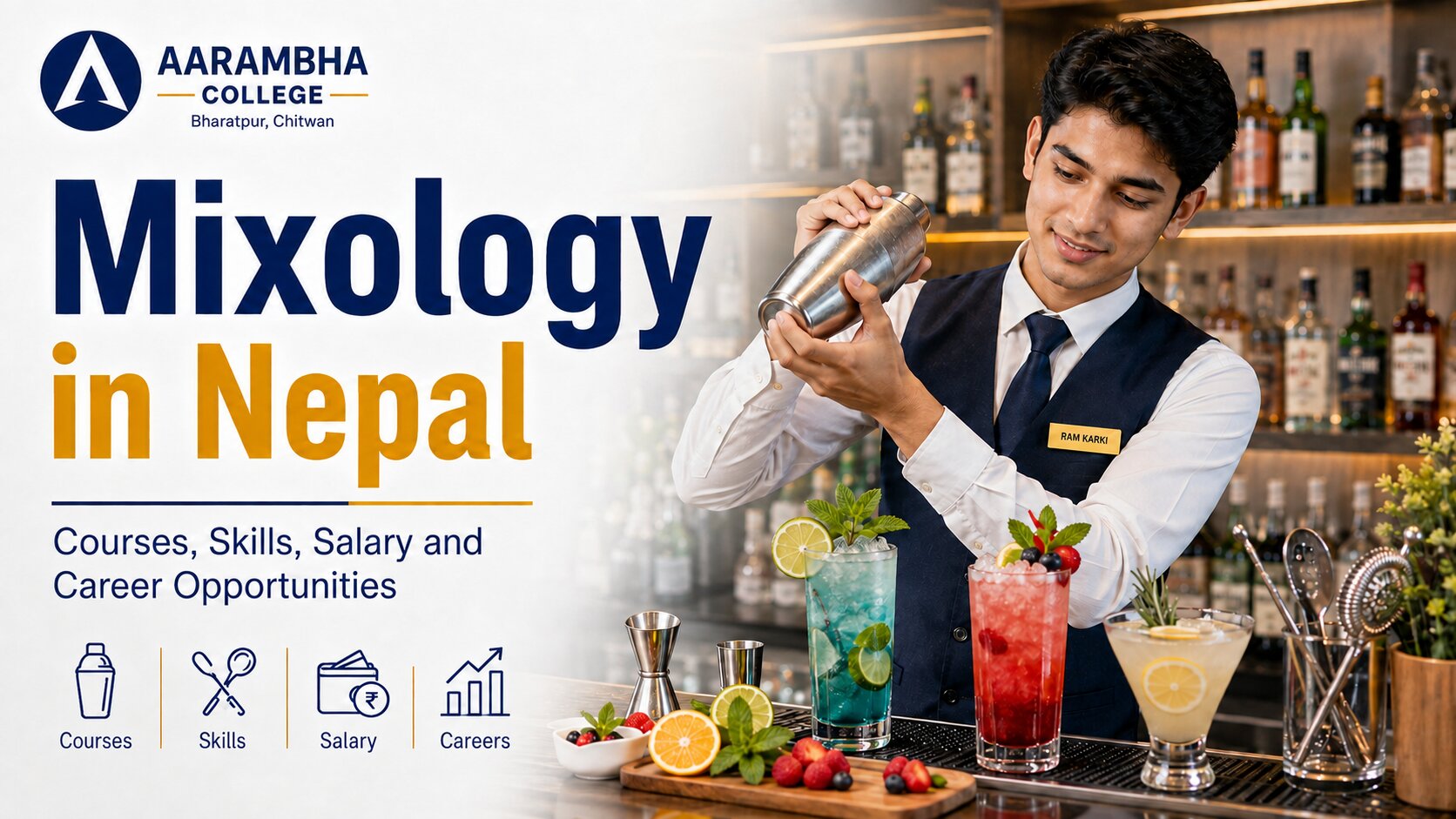
Mixology in Nepal is becoming an interesting career area for students who enjoy hospitality, beverages, creativity and interacting with people. It goes beyond simply preparing drinks. A skilled mixologist understands flavours, ingredients, presentation, beverage service and the overall experience a guest receives at a bar, restaurant or hotel.
For students considering BHM in Nepal, mixology can also connect naturally with food and beverage studies. The Tribhuvan University BHM curriculum includes Food and Beverage Service, Bar and Beverage Service, Food and Beverage Management and a Barista and Bartending elective, along with industrial exposure.
What Is Mixology?
Mixology is the art and technical study of preparing mixed beverages. It involves understanding how ingredients work together and using that knowledge to create balanced, consistent and well-presented drinks.
- Spirits, liqueurs, wines and beers
- Juices, syrups, herbs, fruits and spices
- Non-alcoholic beverages and mocktails
- Different glassware and garnishing styles
- Flavour combinations and drink presentation
- Measuring, shaking, stirring, muddling and layering techniques
- Guest preferences, beverage trends, portion control, hygiene and the commercial side of beverage service
A professional does not simply ask, “What ingredients go into this drink?” They also consider flavour, aroma, balance, appearance, consistency and how the beverage fits the guest experience.
What Is the Difference Between a Mixologist and a Bartender?
The terms bartender and mixologist are closely related, and hospitality employers may sometimes use them differently. In simple terms, bartending focuses on running bar service efficiently, while mixology places more emphasis on beverage knowledge, drink development and creativity.
|
Area |
Bartender |
Mixologist |
|
Main focus |
Preparing and serving drinks |
Understanding and developing mixed beverages |
|
Guest service |
Very important |
Important |
|
Bar operations |
Major responsibility |
Usually understands them |
|
Cocktail knowledge |
Required |
Often more specialised |
|
Drink development |
May create drinks |
Common area of focus |
|
Inventory and bar setup |
Common responsibility |
May also be involved |
|
Creativity |
Useful |
Often central to the role |
A person does not necessarily begin a hospitality career with the title “mixologist.” Many professionals first learn bartending, bar operations and guest service before developing deeper expertise in cocktails and beverage creation.
For this reason, students searching for a mixology course in Nepal will often find the subject included within professional bartending programmes.
Why Is Mixology Important in the Hospitality Industry?
Food and beverage service is an important part of hotels, resorts, restaurants, lounges and event venues. Mixology supports both guest satisfaction and efficient beverage operations, making it a useful skill within the hospitality industry.
A skilled beverage professional can contribute by:
- Preparing drinks consistently: Following the correct measurements and preparation methods so guests receive the same quality every time.
- Maintaining presentation standards: Using suitable glassware, garnishes and serving styles to improve the overall beverage experience.
- Understanding guest preferences: Recommending or preparing drinks based on taste preferences and individual requests.
- Controlling portions and reducing wastage: Measuring ingredients accurately to maintain quality while helping control beverage costs.
- Following hygiene and service procedures: Keeping equipment, glassware and work areas clean while maintaining professional service standards.
- Helping develop beverage menus: Contributing ideas for cocktails, mocktails and other drinks that suit the venue and its customers.
- Supporting efficient bar operations: Organising the workstation, handling orders efficiently and coordinating with other hospitality staff.
- Creating memorable guest experiences: Combining technical skills, presentation and professional interaction to make beverage service more enjoyable.
Mixology therefore combines technical beverage skills, creativity and hospitality service. Students interested in developing these practical abilities can also explore this guide to what makes effective hospitality training.
What Is the Scope of Mixology in Nepal?
The scope of mixology in Nepal is growing with the hospitality industry, creating opportunities in hotels, restaurants, resorts, lounges and other food and beverage businesses. Mixology is a specialised hospitality skill that students can develop through practical bartending and beverage training.
Potential workplaces include:
- Hotels and resorts: Work in hotel bars, restaurants, poolside outlets, banquets and other food and beverage departments.
- Restaurants: Prepare cocktails, mocktails and signature beverages while supporting overall guest service.
- Bars and lounges: Develop stronger bartending, beverage presentation and customer-service skills in specialised bar environments.
- Clubs: Handle high-volume beverage service while maintaining speed, consistency and presentation.
- Banquet and event venues: Prepare and serve beverages for weddings, corporate functions and large hospitality events.
- Hospitality groups: Build experience across multiple restaurants, hotels or beverage outlets operated by the same company.
- Catering businesses: Support beverage service for private functions, outdoor events and corporate programmes.
- Beverage companies: Explore roles related to product promotion, beverage training, brand events or menu development.
- International hospitality businesses: Use hospitality and beverage-service experience to pursue suitable opportunities abroad, subject to employer and destination requirements.
Students who want to understand the wider career environment can also explore the scope of hotel management in Nepal.
What Skills Are Required to Become a Mixologist?
Becoming a skilled mixologist requires a combination of beverage knowledge, practical technique, creativity and customer-service skills. Students need to understand not only how drinks are prepared, but also how to work accurately, communicate with guests and maintain professional service standards.
Beverage knowledge
Students should understand ingredients, flavour profiles, glassware, preparation methods and appropriate serving techniques.
Measuring and consistency
Professional drinks should be repeatable. Accurate measurement helps maintain flavour, portion control and cost.
Taste and flavour understanding
Learning how sweet, sour, bitter, aromatic and other flavour elements interact helps students understand why recipes work.
Creativity
As experience grows, a mixologist may experiment with ingredients, garnishes, presentation and original beverage concepts.
Communication
Hospitality professionals regularly interact with guests and colleagues. Listening, explaining recommendations and communicating professionally are essential.
Speed and organisation
Busy food and beverage outlets require professionals to work efficiently without allowing service quality to fall.
Hygiene and safety
Workstations, equipment, glassware and ingredients must be handled according to appropriate hygiene and workplace procedures.
Responsible service
Anyone working with alcoholic beverages also needs to understand responsible service, workplace rules and the legal requirements applicable to the establishment and destination.
What Does Mixology Training in Nepal Include?
The exact curriculum depends on the training provider. A bartending course in Nepal or dedicated mixology programme may cover:
- Introduction to bar operations
- Beverage categories
- Bar tools and equipment
- Glassware
- Cocktail and mocktail preparation
- Measuring and pouring
- Shaking, stirring and muddling
- Garnishing and presentation
- Beverage service
- Bar hygiene
- Customer interaction
- Inventory and portion control
- Basic flair techniques
- Responsible beverage service
Course duration also varies. Current Nepal-based programmes range from several weeks to longer certificate programmes depending on the training depth and provider. Students should therefore compare the syllabus, practical hours, instructor experience, facilities and assessment method instead of choosing only by course duration or advertising claims.
How Is Mixology Connected With BHM?
Mixology fits naturally within the food and beverage side of BHM. The TU BHM curriculum includes Food and Beverage Service, Bar and Beverage Service, Food and Beverage Management, and a Barista and Bartending elective, giving students a broader hospitality foundation alongside beverage-related skills.
A BHM student also develops knowledge in areas such as:
- Hotel operations: How different hotel departments work together.
- Food production: Basic kitchen operations, preparation and food service.
- Guest service: Professional communication and customer handling.
- Management: Planning, teamwork and hospitality operations.
- Cost and accounting: Understanding costs, pricing and basic financial control.
- Marketing: Promoting hospitality products and services.
- Event management: Planning and supporting hospitality events.
- Hospitality law: Understanding relevant legal and workplace responsibilities.
- Entrepreneurship: Developing business and hospitality venture ideas.
- Industrial exposure: Applying classroom learning in real hospitality environments.
Students can review the BHM course structure, subjects and career prospects to understand how food and beverage studies fit within the complete degree.
What Career Opportunities Are Available for Mixologists?
A career in mixology can develop across different levels of food and beverage service. With experience, practical skills and stronger management ability, students may progress from entry-level bar roles to supervisory, specialist or entrepreneurial positions.
Possible career opportunities include:
- Bar assistant: Support bar setup, stock handling and basic service tasks.
- Bartender: Prepare and serve beverages while interacting with guests.
- Senior bartender: Handle more complex service and support junior staff.
- Mixologist: Focus on beverage knowledge, presentation and drink development.
- Head bartender: Lead the bar team and maintain service standards.
- Bar supervisor: Monitor staff, service quality and daily operations.
- Bar manager: Manage staffing, inventory, costs and overall bar performance.
- Food and beverage supervisor: Support wider restaurant and beverage operations.
- Beverage trainer: Train staff in beverage knowledge and service techniques.
- Beverage consultant: Advise hospitality businesses on menus and bar operations.
- Beverage menu developer: Help create cocktails, mocktails and signature drinks.
- Event bartender: Provide beverage service at weddings, parties and corporate events.
- Hospitality entrepreneur: Start or manage a bar, café, lounge or beverage-focused business.
International opportunities may also be available in hotels, resorts, restaurant groups, cruise hospitality and other food and beverage operations, depending on experience, employer requirements and work-permit rules.
How Much Can a Mixologist Earn in Nepal?
Mixologist earnings in Nepal vary based on experience, workplace, responsibilities and practical skill level. As an indicative market estimate, a Nepal employment guide published in 2026 reports the following monthly bartender salary ranges:
|
Experience/Workplace |
Indicative Monthly Salary |
|
Entry-level |
NPR 15,000–25,000 |
|
Experienced |
NPR 30,000–45,000 |
|
Some luxury hotels, clubs or high-end venues |
NPR 50,000–70,000+ |
These figures are market estimates rather than guaranteed salaries. Actual earnings may be influenced by:
- Experience: More industry exposure can support access to higher-level roles.
- Technical skill: Strong preparation, presentation and beverage knowledge can improve earning potential.
- Employer: Salaries can differ between local restaurants, hotels, resorts and premium venues.
- Location: Earnings may vary depending on the city and local hospitality market.
- Position: Senior bartenders, supervisors and managers usually carry more responsibility.
- Shift schedule: Evening, weekend or high-demand shifts may affect total earnings.
- Tips and service benefits: Some workplaces provide additional income beyond the basic salary.
- Leadership ability: Staff supervision and operational skills can support career progression.
- Specialised mixology skills: Advanced beverage knowledge and menu-development ability may improve access to specialist roles.
Students should look at long-term career progression and skill development, not only the starting salary.
How Can Students Start a Career in Mixology?
A student interested in a mixologist career in Nepal can build skills progressively.
1. Learn hospitality fundamentals
Understand customer service, food and beverage operations, hygiene and professional behaviour.
2. Develop practical bartending skills
Learn tools, glassware, standard drinks, beverage categories, measurement and service techniques.
3. Practise consistently
Mixology requires physical skills. Measuring, shaking, stirring, pouring, garnishing and workstation organisation improve through repetition.
4. Gain real industry exposure
Internships, trainee positions and entry-level food and beverage jobs help students understand actual guest expectations and workplace pressure.
5. Build beverage knowledge
Learn why different ingredients work together instead of memorising recipes without understanding them.
6. Develop communication skills
Technical talent alone is not enough in hospitality. Professional communication and guest interaction matter greatly.
7. Keep learning
Beverage menus, customer preferences and hospitality concepts continue to change. Professionals who continue learning can gradually move towards more specialised roles.
Why Is Practical Training Important for Hospitality Students?
A student can read how a cocktail is prepared, but reading alone cannot teach the hand movement, timing, organisation and confidence needed during actual service.
Practical training allows hospitality students to:
- Work with professional equipment
- Improve speed and accuracy
- Practise service procedures
- Learn from mistakes
- Understand workplace pressure
- Develop teamwork
- Improve guest communication
- Connect classroom theory with real operations
The TU BHM structure itself places significant emphasis on practical assessment in operational subjects and includes structured industrial exposure in the later stages of the degree.
What Is the Future of Mixology in Nepal?
The future of mixology in Nepal is closely linked to the growth of tourism, hotels, restaurants and changing customer expectations. As hospitality businesses focus more on guest experience, beverage presentation, creativity, consistency and professional service are likely to become more important.
There is also growing scope beyond alcoholic cocktails. Modern beverage professionals can work with:
- Mocktails
- Zero-alcohol beverages
- Coffee-based creations
- Tea-based drinks
- Local ingredients
- Seasonal flavours
- Signature restaurant beverages
- Event beverage menus
Students who combine creativity with beverage knowledge, guest service, cost control and hospitality operations can build more flexible long-term career options.
Start Building Your Hospitality Career at Aarambha College
Mixology can be a valuable skill for students interested in food and beverage service, but a long-term hospitality career also requires knowledge of guest service, hotel operations, management and practical industry experience.
Students who want to build a broader hospitality foundation can explore the BHM programme in Chitwan and learn how BHM studies can support careers in food and beverage, hotel operations and the wider hospitality industry.
FAQs
What is mixology in simple words?
Mixology is the skill of preparing and creating mixed drinks using the right ingredients, flavours, techniques and presentation.
Is a mixologist the same as a bartender?
Not exactly. A bartender mainly serves and prepares drinks, while a mixologist focuses more on beverage knowledge, flavour combinations and drink creation.
Is there a mixology course in Nepal?
Yes. Several hospitality institutes in Nepal offer bartending and mixology training covering cocktails, mocktails, beverage knowledge and bar operations.
Can I learn mixology while studying BHM?
Yes. BHM includes food and beverage subjects, and the TU curriculum also covers Bar and Beverage Service with a Barista and Bartending elective.
Do I need a BHM degree to become a mixologist?
No. You can enter mixology through specialised training and practical experience, although BHM provides a broader hospitality foundation.
How much does a mixologist earn in Nepal?
Indicative earnings can range from around NPR 15,000–25,000 for entry-level roles to NPR 50,000–70,000+ in some high-end venues.
Can Nepali mixologists work abroad?
Yes, depending on their experience, employer requirements, work permits and the rules of the destination country.
Is mixology a good career after +2 in Nepal?
It can be a suitable option for students interested in hospitality, beverages, creativity and guest service.